Power Flushing Your Radiators: Is It Actually Worth the Money?
Did you know that a single tablespoon of magnetite sludge can reduce your boiler’s heat transfer efficiency by nearly 10%? Over time, the internal corrosion of your radiators creates a thick, black mud that sits silently in your pipes, siphoning money from your bank account every time the thermostat clicks on. This invisible accumulation is the leading cause of boiler breakdowns in the UK, yet it remains one of the most overlooked aspects of home maintenance.
For homeowners in Warrington and Cheshire facing rising energy bills, the concept of spending hundreds of pounds to clean the inside of pipes you cannot see might seem like an unnecessary luxury. However, when you peel back the layers of how a central heating system functions, the economics of power flushing begin to make a compelling case. This guide provides a deep-dive analysis into the process, the costs, the risks, and the ultimate return on investment.
Understanding the Enemy: What is Heating Sludge?
To understand why a power flush might be necessary, one must first understand the chemistry occurring inside your radiators. Your central heating system is essentially a metal loop containing water. While water is excellent for transporting heat, it is also corrosive to steel.
When water meets the steel inside your radiators, a chemical reaction occurs, resulting in iron oxide. There are two main types of iron oxide you need to worry about:
- Red Oxide (Rust): This is less common in sealed systems but occurs where oxygen is present.
- Black Oxide (Magnetite): This is the primary villain. It is a heavy, black sludge that settles at the bottom of radiators, heat exchangers, and pipework loops.
Magnetite is significantly denser than water. Unlike standard dirt that might float along, magnetite creates sedimentary layers. As these layers build up, they act as an insulator. While you want your home insulated, you definitely do not want the inside of your radiators insulated from the hot water flowing through them.
What Exactly is a Power Flush?
A power flush is often confused with a simple "drain down" or a "chemical flush," but the processes are vastly different in terms of intensity and results.
- Gravity/Chemical Flush: This involves adding a cleaning chemical to the system, letting it circulate for a few days, and then draining the water out. It relies on gravity to remove the debris. It is akin to rinsing a muddy plate under a gentle tap.
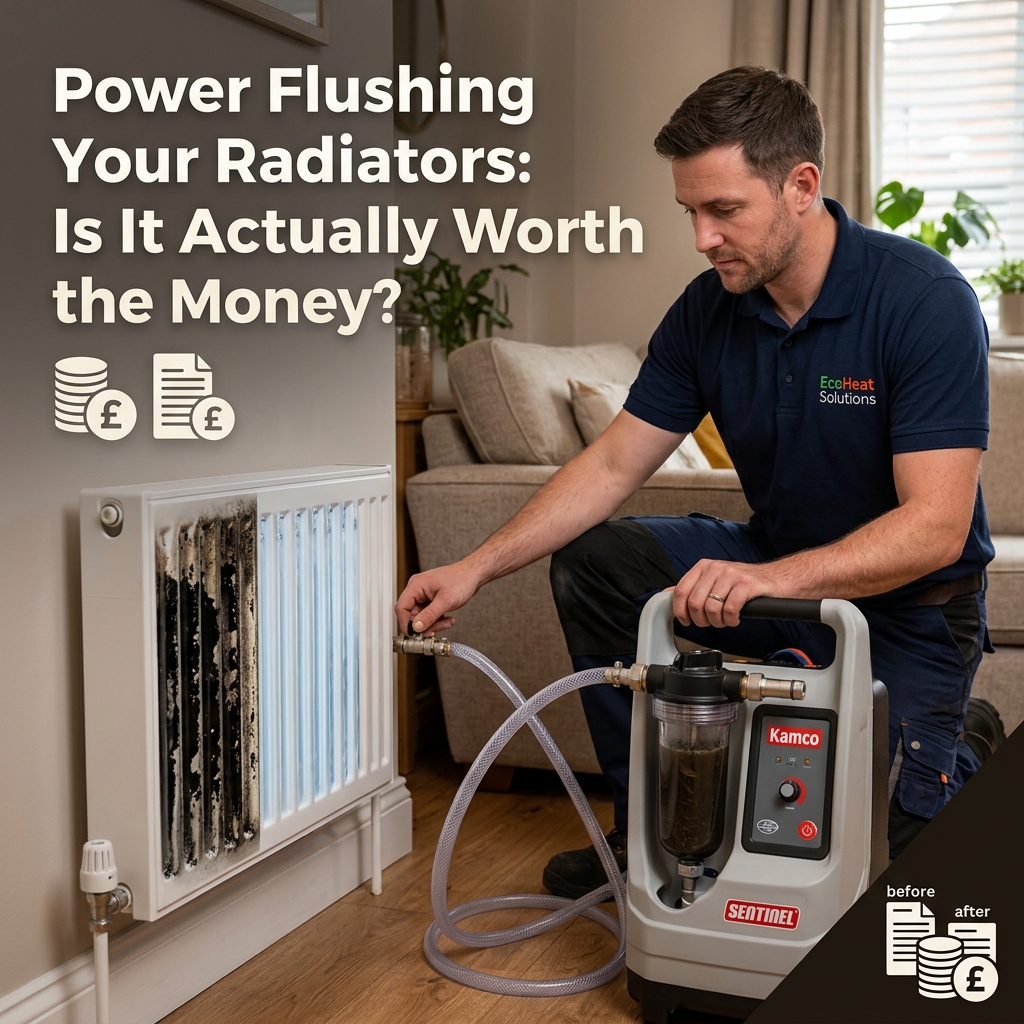
- Power Flush: This is a high-velocity, low-pressure cleaning process. A specialist machine is connected to your central heating system (usually at the pump or outside via a radiator tail). It forces water and powerful cleaning chemicals through the pipes at high speed to dislodge the sludge. Crucially, the machine has a mechanism to reverse the flow of water instantaneously, creating turbulence that knocks stubborn deposits off the internal walls.
Because this process uses aggressive flow rates and specialized chemicals, it is not a DIY job. It generally requires the equipment and expertise of professional Plumbers & Heating Engineers to ensure the system is not over-pressurized, which could blow seals on older pipework.
The 7 Critical Signs Your System Needs Flushing
Before deciding if the expense is "worth it," you need to diagnose if your system is actually suffering from sludge accumulation. If your heating is pristine, a power flush is a waste of money. However, if you notice the following symptoms, your efficiency is likely compromised.
1. Cold Spots at the Bottom of Radiators
This is the hallmark of sludge. Because magnetite is heavy, it settles at the bottom of the panel. Hot water enters the radiator but cannot penetrate the thick layer of mud at the bottom. You will feel heat at the top, but the bottom third remains stone cold.
2. Excessive Noise (Kettling)
If your boiler sounds like a kettle boiling over, it is often due to sludge or limescale narrowing the waterways inside the heat exchanger. This causes the water to flash-boil into steam, creating banging and whistling noises. This is a severe issue that places immense stress on the boiler casting.
3. Frequent Bleeding Required
The chemical reaction that creates sludge produces hydrogen gas as a byproduct. If you find yourself bleeding radiators every few weeks to release air (which is actually hydrogen), your system is actively corroding.
4. Dirty Bleed Water
When you open the bleed valve, catch a small amount of water on a piece of tissue. If it is clear, your system is likely healthy. If it is dark grey or black, you have magnetite circulating in the system.
5. Slow Warm-Up Times
Does your house take an hour to feel warm after the heating kicks on? Sludge restricts flow rates, meaning the pump has to work much harder to push hot water around the circuit, resulting in sluggish performance.
6. Cold Radiators but Hot Pipes
If the copper pipes leading to the radiator are searing hot, but the radiator itself is tepid, the valve or the entry point is likely blocked by debris.
7. Pump Failure
The circulation pump relies on clear water to spin freely. Sludge is abrasive; it wears down the bearings and shafts of pumps, leading to premature failure.
The Economics: Is It Worth the Money?
This is the core question. A professional power flush in the Warrington and Cheshire area can cost between £300 and £600 depending on the size of the property and the number of radiators. Is that outlay justifiable?
The Efficiency Argument
Independent research suggests that severe sludge buildup can reduce system efficiency by up to 15-25%. If your annual gas bill is £2,000, a 20% loss equates to £400 wasted annually. In this scenario, the power flush pays for itself in under two years purely on fuel savings.
The Boiler Lifespan Argument
Replacing a boiler is a significant expense, often costing between £2,000 and £4,000. The number one cause of boiler failure is water quality. If a power flush extends the life of your current boiler by 3 to 5 years, the return on investment is massive.
Furthermore, if you install a brand-new boiler on a dirty system, you are essentially contaminating the new unit immediately. Most boiler manufacturers will void the warranty if the system was not flushed to British Standard (BS 7593) prior to installation. In this context, a power flush is not just worth it; it is an insurance policy for your warranty.
The Property Value Argument
While invisible, a well-maintained heating system is a selling point. Conversely, a surveyor noting "cold spots on radiators" can lead to buyers requesting a reduction in the asking price to cover repairs.
When is Power Flushing NOT Worth It?
While generally beneficial, there are scenarios where power flushing is throwing good money after bad.
1. The System is Too Old
If you have 30-year-old radiators that are rusting from the outside, or pipework that is incredibly fragile, the high pressure of a flush might uncover pinhole leaks. Sometimes, the sludge is the only thing plugging these holes. In such cases, full replacement might be the only viable option.
2. Microbore Pipe Blockages
Microbore pipework (very narrow copper tubes used in some homes built in the 70s and 80s) blocks easily. If the sludge has solidified completely into a rock-like plug, a power flush liquid might simply bypass the blockage rather than clearing it. In these instances, the pipe needs to be cut out and replaced.
3. Electrical vs. Mechanical Faults
Sometimes, homeowners assume their heating is bad due to sludge, when in reality, the controls are at fault. If the boiler fires but the pump doesn't spin, or the zone valves aren't opening, no amount of flushing will fix it. These are wiring or component issues. Before commissioning a flush, it is wise to have qualified Electricians check that the thermostat, programmer, and pump wiring are functioning correctly.
The Power Flush Process: A Step-by-Step Breakdown
For those curious about what happens during the day-long process, here is a detailed breakdown.
Step 1: Setup The engineer connects the power flush unit to the system, usually across the circulation pump couplings or at a radiator tail. The system is then isolated from the cold water feed.
Step 2: Initial Flush Plain water is pumped through the system at high velocity to remove loose debris. The engineer will often go to each radiator individually, closing all others off, to focus the full force of the water on one panel at a time.
Step 3: Chemical Injection A specialized sludge remover (acid-based or neutral, depending on the system age) is added. The boiler is fired up to heat the chemicals, which increases their reaction rate with the sludge.
Step 4: Agitation The engineer may use a rubber mallet or a specialized vibration tool (like a RadHammer) on the external surface of the radiators. This physical agitation helps loosen the stubborn magnetite sticking to the metal walls.
Step 5: Reversing Flow The engineer will periodically reverse the flow direction using the machine's levers. This turbulence is key to scouring the system clean.
Step 6: Dumping The dirty water is pumped out to a drain, and fresh water is introduced. This continues until the water leaving the system is pH neutral and crystal clear.
Step 7: Inhibitor Once clean, the system is filled with a chemical inhibitor. This fluid prevents future corrosion and is essential for maintaining the clean state.
Renovations and Extensions: The Hidden Trap
A common mistake homeowners make is adding a new extension—perhaps a kitchen diner or a conservatory—and connecting brand new radiators to an old, sludgy system. The sludge from the old house will migrate to the new radiators within weeks, potentially ruining them.
If you are undertaking major home improvements, you should coordinate with your Builders & Extensions specialists. They generally recommend flushing the existing system before the new pipework is connected. This ensures the new heating loops remain pristine and the new boiler load is calculated on a clean, efficient system.
DIY Flushing vs. Professional Services
Walk into any hardware store, and you can buy "central heating cleaner." Can you just pour this in and save £500?
Generally, no. A DIY chemical flush relies on the existing central heating pump to circulate the cleaner. Central heating pumps are designed to circulate water gently; they do not have the velocity or pressure required to lift heavy sludge deposits from the bottom of radiators.
Furthermore, DIY flushing carries risks:
- Airlocks: Draining and refilling a system can cause stubborn airlocks that stop the heating entirely.
- Chemical Burns: Strong acidic cleaners can damage carpets, skin, and even the boiler heat exchanger if not flushed out completely.
- Pressurization Issues: Incorrectly repressurizing a combi boiler can lead to pressure relief valves discharging water.
Professional engineers use machines with magnets capable of trapping kilograms of sludge and pumps capable of flow rates far exceeding a standard domestic pump. The value proposition of a professional service is the guarantee of removal, which a bottle of chemicals simply cannot offer.
Maintaining Your System Post-Flush
Once you have invested in a power flush, you want to ensure you never have to do it again—or at least not for another 10 to 15 years. Here is how to maintain that efficiency:
- Magnetic Filters (MagnaClean): Ask your engineer to install a magnetic filter on the return pipe to the boiler. This device catches any new magnetite as it forms, preventing it from entering the boiler. It is a simple device that gets cleaned out during your annual service.
- Inhibitor Levels: The chemical inhibitor eventually dilutes. Have your heating engineer check the inhibitor concentration annually using a test kit. Top it up if necessary.
- Scale Reducers: If you live in a hard water area (common in parts of Cheshire), a scale reducer can prevent limescale buildup in the heat exchanger, which is distinct from sludge but equally damaging.
Final Verdict
Is power flushing worth the money? If your system is showing the classic signs of cold spots, noise, and inefficiency, the answer is a resounding yes. It restores the heating system to near-original efficiency, slashes energy bills, and protects the most expensive appliance in your home—the boiler.
However, it is not a magic wand for broken mechanical parts or severely rotted pipes. Diagnosis is key. Before committing to the cost, ensure you have a reputable tradesperson assess the system to confirm that sludge is indeed the culprit. For homeowners in Warrington, maintaining a clean heating system is one of the smartest investments you can make for long-term comfort and financial savings.
Enjoyed this article?
Need a Verified Tradesperson in Warrington?
Browse verified local professionals across Warrington & Cheshire. Compare reviews, check qualifications, and get free quotes.