How to Vet a Warrington Builder: 10 Critical Questions to Ask Before Hiring
2026 Warrington Builder, Extension & Loft Costs (WA1–WA13)
Accreditation standard: Federation of Master Builders (FMB) & TrustMark
| Common Warrington Job | 2026 Price Range |
|---|---|
| Single-Storey Rear Extension (20m²) | £38,000 – £52,000 |
| Single Garage Conversion to Living Space | £9,500 – £15,000 |
| Load-Bearing Wall Knock-Through (RSJ Steel) | £2,200 – £3,800 |
| Velux / Dormer Loft Conversion | £28,000 – £48,000 |
Why do homeowners routinely hand over tens of thousands of pounds to strangers based on nothing more than a handshake and a gut feeling? The psychology of hiring a builder often defies the logic we strictly apply to buying a used car or even choosing a holiday destination. In the construction industry, unverified optimism is a dangerous strategy that frequently leads to unfinished extensions, spiralling budgets, and sleepless nights.
Finding a builder in Warrington is easy; finding the right builder requires a methodical, investigative approach. Your home is likely your most valuable asset, and entrusting it to a contractor requires due diligence that goes beyond looking at a few photos on a Facebook page. Whether you are planning a double-storey extension in Stockton Heath, a loft conversion in Great Sankey, or a complete renovation in Lymm, the vetting process remains the foundation of a successful project.
This guide moves beyond the basics. We are diving deep into the interrogation tactics professionals use to separate high-quality tradespeople from cowboys. Here are the 10 critical questions you must ask, and exactly what you should listen for in the answers.
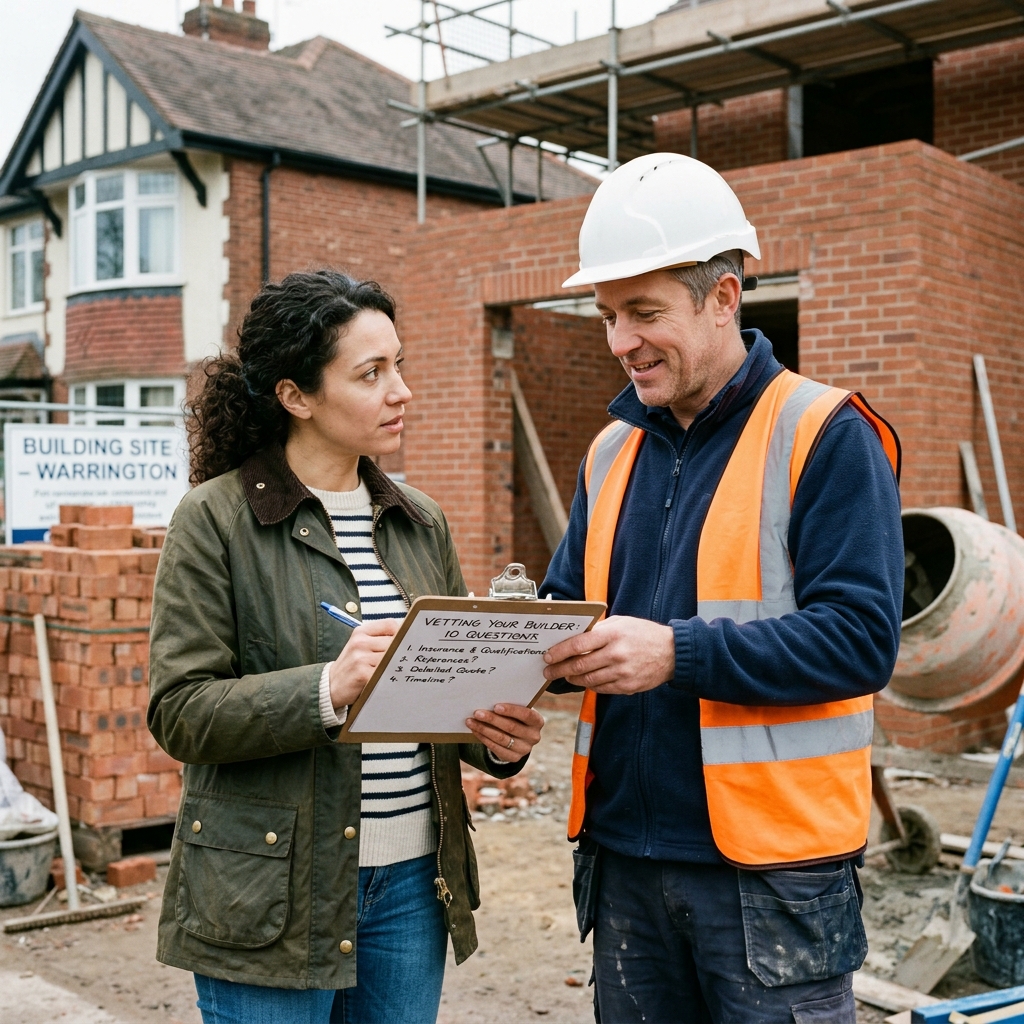
1. "Can I speak to your last three clients and visit a current site?"
Note the specificity here: "last three" and "current site."
Many builders have a "golden portfolio"—a collection of two or three past clients from five years ago who they know will give a glowing review. While those reviews are valid, they do not reflect the builder's current financial stability or operational capacity.
The Deep Dive: You want to talk to the client whose house is currently half-demolished. Why? Because you want to know how the builder behaves when the pressure is on. Ask to visit a site that is currently active.
What to look for on-site:
- Organization: Is the site tidy? A messy site is a dangerous site and often indicates a disorganized mind.
- Punctuality: Are the tradespeople there working, or is the site empty at 10:00 AM?
- Respect: Is the property protected? Are there dust sheets? Is the radio blasting at an unreasonable volume?
If a builder refuses to let you see a current site or hesitate to provide recent references, walk away immediately.
2. "Who exactly will be managing the site day-to-day?"
There is a common scenario in the building trade known as the "Salesman Switch." You meet the company director—charming, knowledgeable, and articulate. You sign the contract based on your rapport with them. Then, the project starts, and you never see them again. Instead, a foreman you have never met shows up, or worse, the apprentices are left unsupervised.
The Critical Follow-up: You need to know the name of the Site Manager or Foreman. This person is the lynchpin of your project. They are responsible for ordering materials, scheduling subcontractors, and ensuring the build follows the architectural drawings.
Ask to meet the foreman before you sign the contract. If the builder cannot tell you who will be running your job, it implies they are juggling too many projects and have not allocated resources to yours yet. This is a precursor to delays.
3. "How do you handle specialist work like electrical and plumbing?"
A general builder is like a conductor; they direct the orchestra, but they shouldn't be playing every instrument. One of the biggest red flags in construction is the "Jack of all trades" who claims they will do the bricklaying, the wiring, the joinery, and the boiler installation themselves.
For complex renovations, you need certified specialists. This is non-negotiable for safety and legality.
Electrical Safety: Unless the builder is Part P registered, they should not be touching your fuse board or installing new circuits. Ask if they use verified Electricians for all wiring tasks. You need to ensure that the electrician they use will provide a BS7671 certificate upon completion. Without this, you will struggle to sell your house in the future.
Plumbing and Heating: Similarly, if your project involves moving a boiler, installing gas hobs, or extensive pipework, specific accreditations are required. Gas work must be carried out by a Gas Safe registered engineer. Ask your builder for the license number of the Plumbers & Heating Engineers they intend to sub-contract to. Verifying these details before work begins protects you from illegal and dangerous installations.
4. "Do you provide a fixed-price quote or an estimate?"
Understanding the difference between these two words can save you thousands of pounds.
- Estimate: A best guess. It is not legally binding. If materials cost more or the work takes longer, the price goes up. Estimates are useful for initial budgeting but dangerous for contracts.
- Quote: A fixed price offer to do the work specified.
The Trap: Be wary of "Day Work" rates for the entire project. While day rates are acceptable for small, unforeseen snags, hiring a builder on a day rate for a large extension gives them no incentive to work efficiently. In fact, the slower they work, the more they get paid.
Push for a fixed-price quotation that breaks down labor and materials. This document should reference your architectural drawings specifically. If the drawing is not mentioned, the builder can later claim, "That wasn't included in the price."
5. "What is your payment schedule?"
Never, under any circumstances, pay the full amount upfront. If a builder asks for 100%—or even 50%—before tools are dropped, it is a massive red flag indicating cash flow problems.
The Ideal Structure: A professional payment schedule is tied to milestones (stages of work completed), not dates on a calendar. For example:
- Deposit: 10-15% (to book the slot).
- Foundations: Payment upon completion and building control sign-off.
- Wall Plate/First Floor: Payment upon reaching this height.
- Roof On/Watertight: Significant payment milestone.
- First Fix (Plumbing/Electric): Payment upon completion.
- Plastering: Payment upon completion.
- Retention: Keep 5% back until the "snagging list" is completed.
By tying payments to physical progress, you maintain leverage. If the builder stops working, you haven't paid for work that hasn't been done yet.
6. "Are you fully insured, and can I see the certificates?"
"Yes, I'm insured" is not a sufficient answer. You need to see the paperwork. You are looking for two specific types of insurance:
- Public Liability Insurance: This covers damage to your property or injury to third parties (like a neighbor or a passerby). For structural work in Warrington, look for coverage of at least £2 million, though £5 million is preferable.
- Employers' Liability Insurance: This is mandatory if the builder employs anyone. If an employee is injured on your site and the builder doesn't have this, you could theoretically be drawn into legal complications.
Contractors' All Risk Insurance: Ideally, for large extensions, the builder should have this. It covers the work in progress. If a storm blows down a half-built wall, this insurance pays to rebuild it. Without it, you might be asked to pay for the same wall twice.
7. "What is your timeline, and how do you handle delays?"
Construction is unpredictable. Weather in Cheshire is notoriously fickle, and supply chains can be disrupted. However, a professional builder will have a program of works—a Gantt chart or a schedule outlining exactly what should happen week by week.
The Conversation to Have: Ask: "What happens if we run over schedule?"
Listen for accountability. A bad builder will blame suppliers or the weather immediately. A good builder will explain their contingency plans. They might say, "If we can't do the brickwork due to rain, we move the team inside to start the knock-through or prep the floors."
Furthermore, if the timeline is critical for you (e.g., you are expecting a baby or need the house ready for Christmas), this needs to be written into the contract. While "penalty clauses" for lateness are rare in residential contracts, having a frank discussion about deadlines sets the tone for the project.
8. "How do you handle scope creep and changes?"
"Scope creep" is the silent budget killer. It starts with, "While you're here, can you just move that socket?" and ends with a £2,000 extra bill at the end of the project.
Disputes over extras are the number one cause of breakdown in the client-builder relationship.
The Solution: Ask the builder for their formal procedure on "Variations."
Ideally, it should work like this:
- You request a change.
- The builder prices the change in writing (email is fine).
- You agree to the price in writing.
- Only then does the work happen.
If a builder says, "Don't worry, we'll sort it out at the end," be very worried. That is a recipe for a shock invoice.
9. "Who handles the finishing touches?"
Many builders are excellent at the heavy lifting—foundations, steel beams, blockwork—but lack the finesse required for the final aesthetic finish. We have all seen extensions where the structure is solid, but the paintwork is sloppy, or the skirting boards are poorly joined.
Ask specifically about the finishing stages. Does the builder have their own team for this, or do they bring in specialists? For a high-end finish, a general laborer with a paintbrush is rarely sufficient. You want to hear that they use professional Painters & Decorators to ensure the walls, woodwork, and exterior finishes are crisp and flawless.
Similarly, ask about tiling and flooring. These are the surfaces you will touch and see every day. If the builder admits that finishing isn't their strong suit, it might be worth negotiating to exclude the decoration from their quote so you can hire a dedicated specialist yourself.
10. "What warranties and guarantees do you offer?"
Once the van drives away, what protection do you have?
By law, you have rights under the Consumer Rights Act 2015, which states work must be done with reasonable care and skill. However, enforcing this can be difficult without a specific warranty.
Snagging: Ask about their snagging policy. Will they return 30 days after completion to fix minor cracks (which inevitably appear as new plaster dries) or sticking doors?
Third-Party Warranties: For major structural work, ask if they offer an Insurance Backed Guarantee (IBG). This is crucial. If the builder goes out of business six months after finishing your extension, and the roof starts leaking, a standard personal guarantee from the builder is worthless. An IBG protects you even if the company ceases trading.
Check if they are members of the Federation of Master Builders (FMB) or similar bodies, as these memberships often allow them to offer these robust warranties.
The Warrington Context: Planning and Regulation
Beyond vetting the individual, you must vet their knowledge of local regulations. Warrington Borough Council has specific requirements regarding planning permission and building control.
An experienced local builder should be familiar with the soil conditions in different parts of Warrington. For example, areas near the Mersey or the Manchester Ship Canal may require specialized piling or deep trench foundations due to high water tables or sandy soil.
Ask them: "Have you worked in this specific postcode before? Are you aware of any ground condition issues in this area?" Their answer will reveal if they truly know the local terrain or if they are just guessing.
The Role of Contracts
Never proceed without a written contract. A quote is not a contract.
For homeowners, the JCT (Joint Contracts Tribunal) Homeowner Contract is the gold standard. It protects both you and the builder. It lays out the payment terms, the timeline, the dispute resolution process, and insurance requirements.
If a builder refuses to sign a standard contract and insists on working off a verbal agreement or a one-page invoice, this is a fatal error. The contract is your rulebook. Without it, you are playing a game where the rules can change daily.
Summary: The Value of Due Diligence
Vetting a builder takes time. It involves phone calls, site visits, and awkward questions. It requires you to be firm and detail-oriented. However, compare this time investment to the duration of the build—potentially three to six months—and the cost of the project.
Spending ten hours vetting your builder could save you ten weeks of delays and £10,000 in remedial costs.
Warrington has an abundance of incredible, skilled tradespeople—expert bricklayers, visionary landscapers, and meticulous joiners. They take pride in their work and will welcome your questions because they have nothing to hide. These are the professionals you want on your team.
By asking these ten critical questions, you filter out the cowboys and pave the way for a renovation that adds value to your home and quality to your life. Take your time, trust the process, and build with confidence.
Enjoyed this article?
Need a Verified Tradesperson in Warrington?
Browse verified local professionals across Warrington & Cheshire. Compare reviews, check qualifications, and get free quotes.