EV Charger Installation: What Warrington Homeowners Need to Know
2026 Warrington 7kW Home EV Charger Installation Costs (WA1–WA13)
Accreditation standard: NICEIC / NAPIT Part P & OZEV Approved
| Common Warrington Job | 2026 Price Range |
|---|---|
| 7kW Smart EV Charger (Untethered, Supply & Standard Fit) | £850 – £1,100 |
| 7kW Tethered Solar-Compatible EV Charger (Zappi / Ohme / Hypervolt) | £950 – £1,250 |
| Dedicated EV Mini-Consumer Unit with Type A RCBO & SPD | £160 – £260 |
| Long SWA Armoured Cable Run to Detached Garage (>15m) | £180 – £380 |
Waking up to a half-empty battery because you relied on a standard three-pin plug is a frustration that can derail your entire morning commute through Bridge Foot or the M62. This 'range anxiety' doesn't just happen on the road; it starts on your driveway when your charging setup fails to keep pace with your lifestyle. Professional home charging is the only way to ensure your electric vehicle is as ready for the day as you are, providing safety, speed, and long-term cost savings.
As the UK transitions away from internal combustion engines, Warrington has seen a significant surge in EV adoption. From Great Sankey to Grappenhall, more homeowners are trading in their petrol tanks for lithium-ion batteries. However, buying the car is only half the battle. The real transformation happens when you install a dedicated home charging point. In this deep-dive guide, we will explore everything a Warrington resident needs to know about EV charger installation, from technical requirements and local grants to finding the right professionals to handle the job.
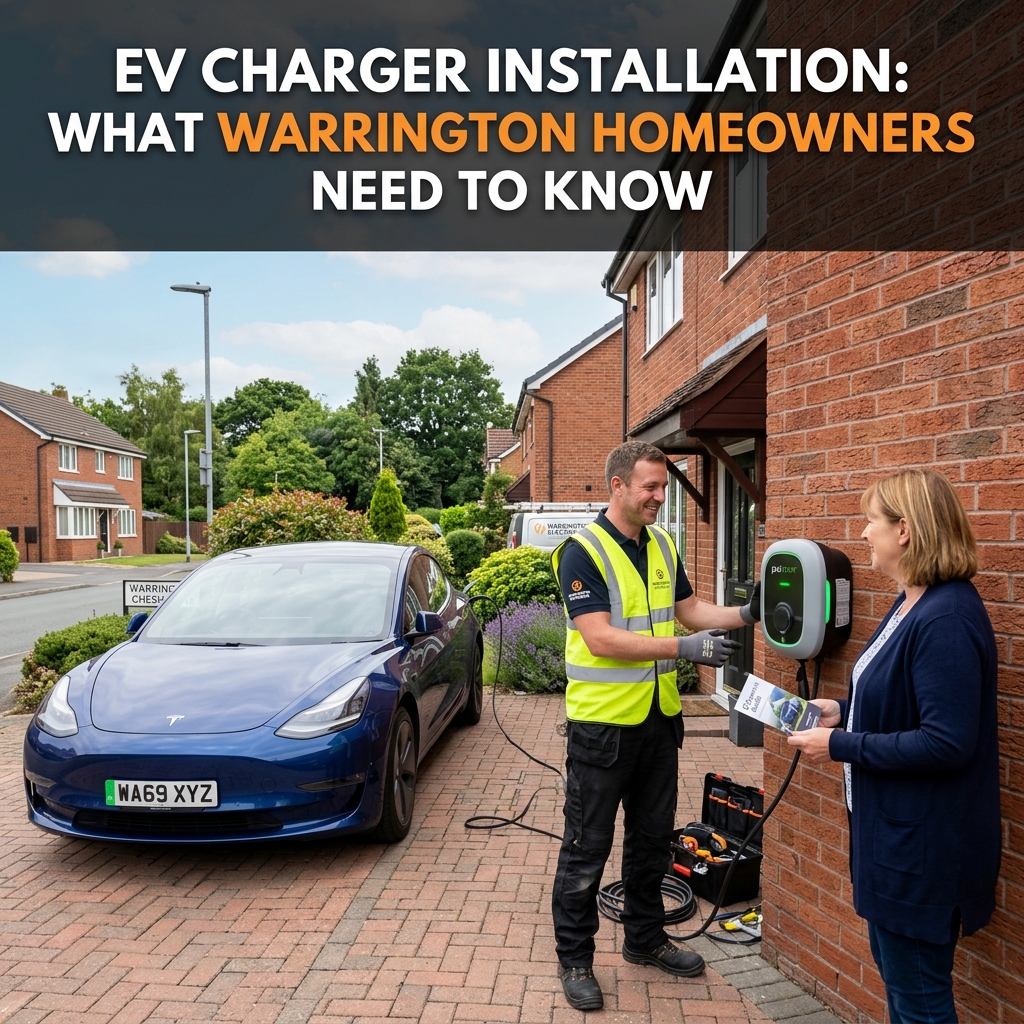
The Shift to Electric in Warrington and Cheshire
Warrington sits at a unique geographical crossroads. Positioned perfectly between Manchester and Liverpool, and intersected by the M6, M62, and M56, our town is a commuter hub. This makes the shift to electric vehicles particularly impactful here. Local residents are finding that while the public charging infrastructure in Cheshire is improving, it cannot beat the convenience of plugging in overnight at home.
With the expansion of low-emission zones in nearby cities and the rising cost of traditional fuel, the economic argument for EVs has never been stronger. However, the efficiency of an EV is heavily dependent on how you charge it. Relying on public rapid chargers is not only more expensive—often costing triple what you would pay on a domestic night-rate tariff—but it also adds significant time to your weekly routine.
Why Home Charging is Non-Negotiable
Many new EV owners begin their journey using a 'granny cable'—a portable charger that plugs into a standard UK 13-amp socket. While this works in an emergency, it is not a long-term solution. A standard socket is not designed to run at full power for 12 or 14 hours straight, which can lead to overheating and, in extreme cases, electrical fires.
A dedicated home EV charger (Wallbox) communicates directly with your car. It is designed to handle high current safely and can charge your vehicle up to three times faster than a standard plug. For most Warrington homeowners, a 7kW charger is the standard, which can fully charge a typical 60kWh battery in about 8 to 10 hours—perfectly timed for an overnight session.
Technical Requirements for Installation
Before you click 'buy' on a sleek new charger, you need to understand the technical constraints of your property. Most homes in Warrington have a single-phase electricity supply. This typically allows for a maximum charging rate of 7.4kW. While you may see 22kW 'three-phase' chargers advertised, these are usually reserved for commercial premises or very large modern homes. Upgrading a domestic property to three-phase power can cost thousands, so for 95% of residents, a 7kW unit is the gold standard.
The Site Survey
A professional installer will always begin with a site survey. They will check:
- The Consumer Unit (Fuse Box): Is there enough space for a new high-load circuit? If your fuse box is several decades old, you might need an upgrade before the charger can be safely installed.
- The Main Fuse: Most UK homes have a 60-amp or 100-amp main fuse. If your home uses a lot of electricity (e.g., electric showers, induction hobs), adding a 32-amp EV charger might exceed your total capacity. Your installer may need to fit a 'load management' device that throttles the charger when other high-power appliances are in use.
- The Distance: Where is your meter box in relation to where you park your car? The longer the cable run, the higher the installation cost.
Integrating the Installation into Your Home
An EV charger isn't just an electrical appliance; it’s a permanent fixture on your property’s exterior. This often means the installation overlaps with other home improvement projects.
For instance, if you are planning to build a new garage or extend your driveway to accommodate your new vehicle, you should coordinate the charger installation with your construction schedule. If your project involves structural changes, it is wise to consult Builders in Warrington who can ensure the cable routes are integrated into the build, avoiding the need to retroactively drill through new brickwork or foundations.
Similarly, the aesthetics of your front garden matter. Nobody wants a thick black cable draped across a pristine lawn or a messy trench cut through a flowerbed. If your charger needs to be located away from the house—perhaps on a pedestal at the end of a driveway—you should involve Gardeners & Landscapers in Warrington. They can help by professionally trenching the cable run and reinstating your turf or paving so that the installation is virtually invisible once complete.
Finally, consider the wider utility impact. Many homeowners use the transition to an EV as a catalyst for a broader 'green' home upgrade. This might include installing outdoor taps for car washing or upgrading utility rooms where the charging controls are often housed. In these instances, Plumbers in Warrington can assist in ensuring your external plumbing and internal utility layouts don't interfere with the new high-voltage electrical paths.
Choosing the Right Hardware: Tethered vs. Untethered
One of the first decisions you'll face is whether to go for a tethered or untethered unit.
- Tethered: These units have the cable permanently attached. It’s the ultimate in convenience—you simply pull up and plug in. However, you are 'locked in' to that cable length and connector type (though almost all modern EVs use Type 2).
- Untethered (Socketed): These units look neater on the wall because they don't have a dangling cable. You use the cable that came with your car. This is more 'future-proof' if connector standards ever change, but it means you have to get your cable out of the boot every time you want to charge.
The Role of the DNO (Distribution Network Operator)
In Warrington, our electricity network is managed by SP Energy Networks. When an EV charger is installed, the installer must notify the DNO. This is a legal requirement to ensure the local grid can handle the increased demand. In some cases, if the local substation is near capacity, the DNO might need to perform an 'un-looping' service or upgrade your service cable. A reputable local installer will handle all this paperwork for you.
Costs, Grants, and Savings
The cost of a home EV charger installation in Cheshire typically ranges from £800 to £1,500, depending on the hardware chosen and the complexity of the wiring.
While the OZEV (Office for Zero Emission Vehicles) Grant for single-family homeowners ended in 2022, there are still grants available for:
- Renters and flat owners (£350 off).
- Landlords (residential and commercial).
- Small businesses providing charging for staff.
Even without a grant, the Return on Investment (ROI) is significant. By switching to an EV-specific energy tariff (like those offered by Octopus or OVO), you can charge your car for as little as 7p to 9p per kWh. For a standard EV, this means a full 'tank' of 250+ miles could cost you less than £5. Compare that to the £60–£80 it costs to fill a petrol car, and the charger pays for itself in less than a year for high-mileage drivers.
Smart Charging and Energy Management
Modern chargers are 'smart' by law. This means they connect to your home Wi-Fi and allow you to schedule charging via an app. This is crucial for taking advantage of off-peak electricity rates.
Advanced units like the Zappi or Ohme also offer 'solar diversion.' If you have solar panels on your Warrington home, these chargers can detect when you are exporting excess energy back to the grid and instead redirect that free green energy directly into your car battery. This effectively allows you to drive on sunshine.
Safety and Regulations (Part P)
Electrical safety is paramount. An EV charger is a high-power device that draws a constant high current for hours on end. This places significantly more stress on your home's electrical system than a kettle or an oven.
All installations must comply with Part P of the Building Regulations and the IET Wiring Regulations (BS 7671). This includes the installation of an RCD (Residual Current Device) to prevent electric shocks and PEN fault protection to ensure the car doesn't become 'live' if there is a fault with the street's neutral wire. Never hire an uncertified 'handyman' for this job; always ensure your installer is NAPIT or NICEIC registered.
Step-by-Step Installation Process
- Initial Consultation: You provide photos of your consumer unit and preferred mounting location.
- Quote and Technical Check: The installer confirms if your supply needs an upgrade.
- DNO Notification: Your installer informs SP Energy Networks.
- Physical Installation: The unit is mounted, and the cable is run from the consumer unit. This usually takes 3 to 5 hours.
- Testing and Commissioning: The installer uses a 'dummy' load to test the safety features of the charger.
- App Setup: You are shown how to use the scheduling software to save money.
- Certification: You receive an Electrical Installation Certificate (EIC).
Preparing for the Future
As you look around your property, think about the long term. If you have two cars, you might want to consider a dual-port charger or at least ensure your consumer unit has the capacity to add a second unit later.
Warrington is an area with a diverse range of housing, from Victorian terraces in Latchford to modern builds in Chapelford. Each presents its own challenges. Victorian homes often have older wiring that needs more attention, while modern estates might have restrictive covenants or shared driveways that require careful legal and physical planning.
If your installation requires significant groundwork—such as lifting block paving or running cables under a shared access path—ensure you are working with professionals who understand local property types. This is where the synergy between different trades becomes vital. Whether it’s the structural expertise of Builders in Warrington to handle wall penetrations, or the aesthetic touch of Gardeners & Landscapers in Warrington to hide the evidence of a cable trench, a holistic approach to your EV transition will yield the best results. And of course, if your new charging station is part of a wider garage-to-utility conversion, having Plumbers in Warrington on hand ensures all your services are modernised simultaneously.
Finding a Vetted Installer in Warrington
With the boom in EVs, many new installation companies have popped up overnight. It is vital to choose a tradesperson with a local reputation and a history of quality work. Look for installers who are not just 'electricians' but 'EV specialists' who understand the specific nuances of load balancing and smart software integration.
Warrington Tradesmen is designed to help you bridge this gap. By connecting you with vetted, local professionals who know the specific electrical infrastructure of the Cheshire West and Chester/Warrington areas, you can ensure your installation is safe, legal, and efficient.
Conclusion
Transitioning to an electric vehicle is an exciting step toward a more sustainable and cost-effective lifestyle. By installing a high-quality home charger, you remove the stress of public charging and unlock the true potential of your EV. While the technical details—from RCDs to DNO notifications—might seem daunting, the right team of local professionals can make the process seamless.
Don't let a slow 'granny cable' hold you back. Invest in a dedicated home charging point and start every morning with a full battery, ready to take on the roads of Warrington and beyond. Whether you need a simple wall mount or a complex multi-trade driveway renovation, our local directory is here to ensure you find the highest quality help in the North West.
Enjoyed this article?
Need a Verified Tradesperson in Warrington?
Browse verified local professionals across Warrington & Cheshire. Compare reviews, check qualifications, and get free quotes.