Are Your Locks Insurance-Approved? A Warrington Locksmith's Guide
When you take out a home insurance policy, you’re buying peace of mind. It’s a safety net, there to catch you if the worst happens. But what if a tiny detail, like the type of lock on your front door, could render that entire policy void? For many Warrington homeowners, this is a genuine risk they are unaware of. The question, 'Are your locks insurance-approved?' is not just about security; it's about financial protection. Buried in the small print of most insurance documents is a clause specifying the minimum standard of security your home must have, and at the heart of that is your door and window locks. This guide, direct from the expertise of local Warrington tradespeople, will demystify the standards, help you check your own locks, and ensure your home is both secure and fully compliant.
Why Your Home Insurance Policy Cares So Much About Your Locks
It might seem like a trivial detail, but to an insurer, your locks are a primary indicator of risk. Insurance is a game of statistics and probability. An insurer calculates your premium based on the likelihood of you making a claim. A home with weak, outdated, or non-compliant locks presents a much higher risk of burglary than one secured with high-quality, approved locking mechanisms.
Here’s why they place so much emphasis on it:
- Deterrence: High-security locks are a significant deterrent to opportunistic burglars. Thieves often look for the easiest target. A door with a flimsy lock or an old, vulnerable cylinder is an open invitation. A robust, British Standard lock suggests a more difficult entry, encouraging them to move on.
- Resistance: Insurance-approved locks are tested to withstand common methods of forced entry, such as drilling, picking, and snapping. This physical resistance means that even a determined burglar will have to spend more time and make more noise to gain access, dramatically increasing their chances of being caught.
- The 'Forced Entry' Clause: Most policies will only pay out for theft if there are clear signs of 'forcible and violent' entry. If a burglar can simply bypass a weak lock without leaving a trace (a technique known as lock-snapping or bumping), an insurer could argue that the security was inadequate and refuse to pay your claim.
Failing to meet your insurer's minimum security requirements can have devastating consequences. If you are burgled and your locks are found to be non-compliant, your insurer may have grounds to reduce your settlement or, in the worst-case scenario, reject your claim entirely. They will argue that by not having the specified locks, you failed to take 'reasonable care' to protect your property, a standard clause in most policies. The small saving made by not upgrading a lock could cost you tens of thousands of pounds in uncovered losses.
Decoding the Jargon: What Does 'Insurance-Approved' Actually Mean?
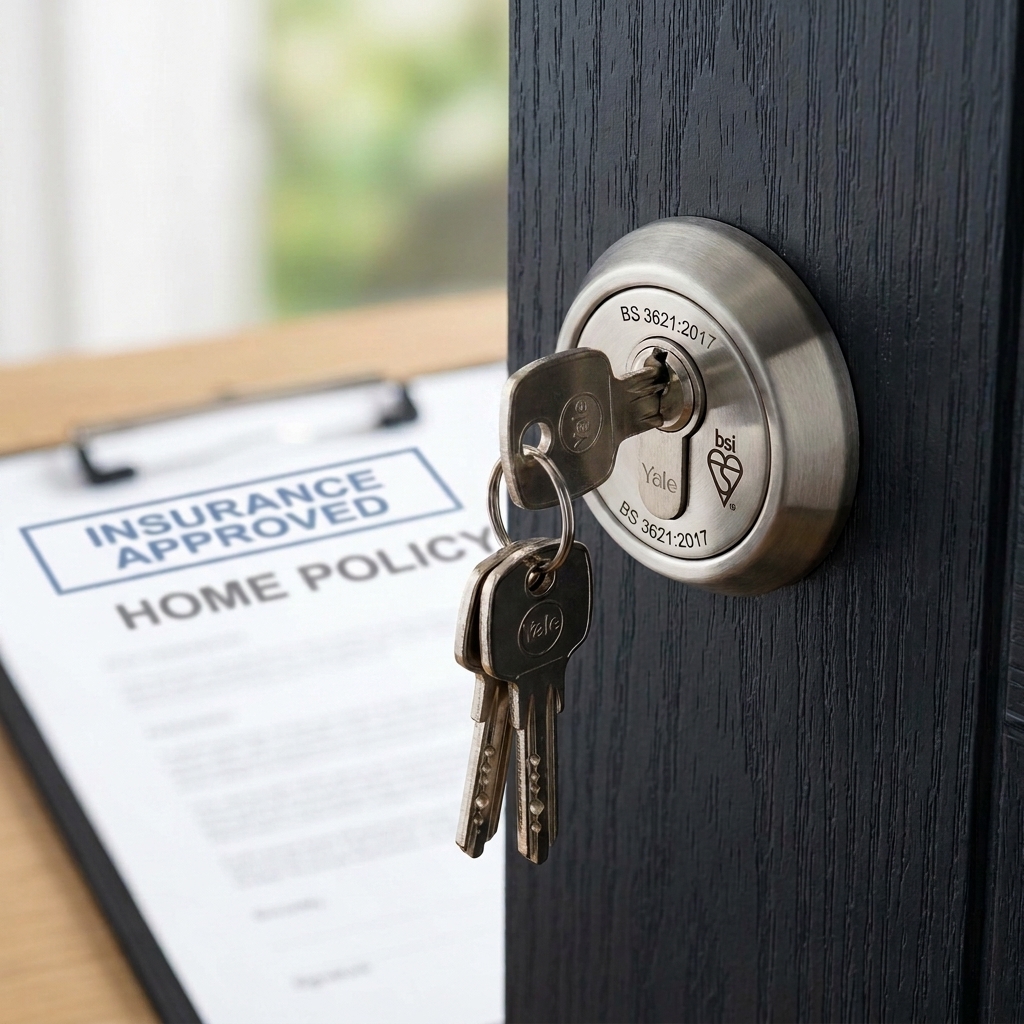
The term 'insurance-approved' isn't just marketing speak. It refers to locks that have been independently tested and certified to meet a specific standard of security and durability. In the UK, the most common standard you'll see is BS3621.
What is BS3621?
BS3621 is a standard set by the British Standards Institution (BSI). When a lock is certified to this standard, it means it has passed rigorous tests designed to simulate a real-world burglary attempt. These tests assess its resistance to:
- Drilling: Using high-speed drills to destroy the internal mechanism.
- Picking: Manipulating the lock pins with specialist tools.
- 'Snapping': A common technique used on uPVC door cylinders where the cylinder is broken in half.
- Cutting/Sawing: Attacking the bolt of the lock itself.
A lock that carries the BS3621 standard is a thief-resistant lock. The key feature is that it can be deadlocked from both the inside and outside, meaning once you've locked it, it cannot be opened from the inside without a key. This prevents a burglar from breaking a small pane of glass, reaching in, and simply turning a thumbturn to unlock the door.
How to Identify a BS3621 Lock
Thankfully, you don't need to be a locksmith to check if your lock is compliant. It's surprisingly easy. Open your door and look at the faceplate of the lock (the metal strip that goes into the door frame). You should see the BSI Kitemark (a heart-shaped symbol) engraved into the metal, along with the standard number: BS3621. If you see this mark, your lock meets the common requirements for most home insurance policies.
For other types of doors, such as communal entrances or doors with no external keyhole, you might see other standards like BS8621 (allows keyless emergency exit) or BS10621 (allows entry from outside but not exit from inside without a key). However, for the main entrance doors of most Warrington homes, BS3621 is the gold standard.
A Practical Lock Check for Your Warrington Home
Let's walk through your property, room by room, and assess the locks you likely have. Grab your keys and take a look.
1. Your Front Door (and other external timber doors)
This is the most critical entry point. Most insurers will insist on a BS3621-approved lock here.
- Mortice Locks: This is the classic 'Chubb' style lock that is embedded into the door itself. To be insurance compliant, it must be a 5-lever mortice deadlock. A 3-lever lock is not considered secure enough. Check the faceplate for the BSI Kitemark and the BS3621 stamp. If it doesn't say 5-lever or have the Kitemark, it likely needs upgrading.
- Night Latches (Yale Locks): A standard night latch on its own is NOT enough for insurance purposes. They provide convenience but not sufficient security. Insurers will require you to have a night latch FITTED IN ADDITION to a BS3621 mortice deadlock. For maximum security, you can get high-security night latches that are also British Standard approved.
2. uPVC and Composite Doors
These doors are very common in modern Warrington properties. They don't use a single mortice lock but a multi-point locking system where several bolts engage along the frame when you lift the handle.
- The Cylinder is Key: The security of the entire system relies on the small euro cylinder that your key goes into. For years, standard cylinders were vulnerable to 'lock-snapping'. An insurance-compliant cylinder must be an anti-snap, or 'snap-safe', model.
- How to Check: Look for the BSI Kitemark and a 'star rating'. A 3-star Kitemarked cylinder is the highest security level and meets all insurance requirements on its own. Alternatively, you might have a 1-star cylinder protected by 2-star rated security handles. The combination (1+2) also equals the 3-star standard. If your cylinder has no stars and no Kitemark, it is almost certainly a standard, vulnerable cylinder that needs immediate replacement.
3. Patio and French Doors
These are often seen as a weak point by burglars. Your insurance policy will have specific requirements here too.
- Multi-point locking systems are common and should be used every time you leave the house.
- For older sliding patio doors, you should have key-operated anti-lift bolts at the top and bottom to prevent the door from being forced off its runners.
- French doors should have key-operated bolts on both doors, securing them into the frame at the top and bottom.
4. Windows
Don't forget your windows! Your policy will state that all accessible windows (usually defined as ground floor and any upper-floor windows near a flat roof or drainpipe) must be fitted with key-operated window locks. Simply having a handle that latches is not enough; a key must be required to open it from the inside. If you have older wooden windows or damaged uPVC locking mechanisms, it's worth getting them assessed. You can find expert advice by checking our list of approved Warrington glaziers and window repair specialists.
Upgrading Your Locks: What's Involved and What to Expect
If you've checked your locks and found they don't meet the BS3621 or 3-star cylinder standard, don't panic. Upgrading them is a straightforward and cost-effective process that significantly boosts your home's security.
Why Hire a Professional Locksmith?
While it might be tempting to buy a lock from a DIY store and fit it yourself, this is a job best left to a professional. A qualified locksmith will:
- Ensure Correct Fitting: An improperly fitted high-security lock can be just as vulnerable as a cheap one. A locksmith ensures it is installed correctly, functions smoothly, and offers maximum protection.
- Provide the Right Product: The market is flooded with locks of varying quality. A professional locksmith will supply genuine, British Standard approved locks from reputable manufacturers.
- Identify Other Weaknesses: A good locksmith will assess your door, frame, and overall security, pointing out other potential vulnerabilities you might have missed.
- Work Efficiently: What might take you half a day of frustration, a skilled locksmith can often complete in under an hour.
When you need to upgrade your security, don't take chances. You can find a trusted and vetted locksmith in Warrington right here on our directory. They can provide a full security survey and ensure your home is fully compliant with your insurance policy.
What are the Costs?
Costs can vary, but here's a rough guide for Warrington homeowners:
- Supply and fit a BS3621 5-lever mortice deadlock: £120 - £180
- Supply and fit a 3-star anti-snap euro cylinder for a uPVC door: £90 - £150
- Labour/Call-out Fee: Most locksmiths will have a standard labour charge, often for the first hour on site. Always confirm costs upfront.
Considering the thousands of pounds at risk if your insurance claim is denied, this is a small and worthwhile investment in your security and financial wellbeing.
Beyond the Front Door: Other Security Insurers Love
While compliant locks are the number one priority, insurers also look favourably on other security measures that demonstrate you are a responsible homeowner. Implementing some of these could even lead to a small discount on your premium.
- Visible Burglar Alarm: A professionally installed and maintained burglar alarm system is a major deterrent. Ensure the external bell box is clearly visible.
- Security Lighting: Motion-activated lights at the front and back of your property eliminate dark hiding spots for potential intruders. This is a simple job for a qualified tradesperson. If you're considering this upgrade, you can browse verified electricians in Warrington to get a professional and safe installation.
- Door Viewers and Chains: These simple devices allow you to identify visitors before opening the door, preventing distraction burglaries.
- Secure Outbuildings: Don't forget sheds and garages. Use high-quality padlocks and consider a shed alarm, especially if you store valuable tools or bicycles inside.
Taking a proactive approach to your home security is one of the most important things you can do as a homeowner here in Warrington. It protects your family, your possessions, and ensures that your insurance policy will be there for you when you need it most. Take ten minutes today to check your locks – it could be the most valuable check you ever make.
Enjoyed this article?
Need a Verified Tradesperson in Warrington?
Browse verified local professionals across Warrington & Cheshire. Compare reviews, check qualifications, and get free quotes.