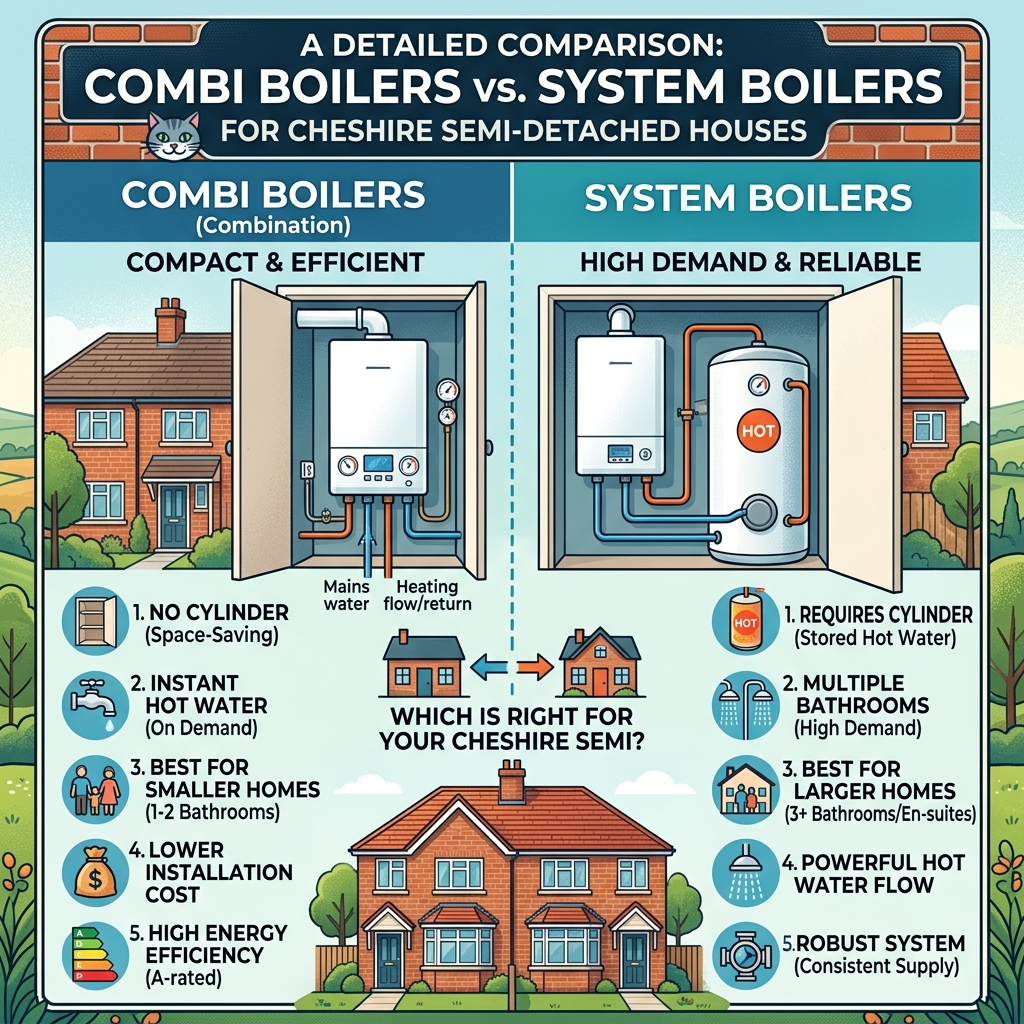
A Detailed Comparison: Combi Boilers vs. System Boilers for Cheshire Semi-Detached Houses
2026 Warrington Boiler Installation & Replacement Costs (WA1–WA13)
Accreditation standard: Gas Safe Register (7-Digit ID Required)
| Common Warrington Job | 2026 Price Range |
|---|---|
| Straight Combi-to-Combi Swap (24kW–30kW) | £1,950 – £2,750 |
| Conventional System to Combi Conversion | £2,600 – £3,800 |
| Smart Thermostat (Hive / Nest) Supply & Fit | £180 – £280 |
| Magnetic Filter & Chemical System Flush | £250 – £450 |
Is the relentless push towards combi boilers actually sabotaging the comfort of larger family homes? While compact heating units dominate marketing brochures, they often fail the "morning rush" test in the typical three-bedroom semi-detached properties found across Warrington and Wilmslow. Before you rip out your hot water cylinder to reclaim an airing cupboard, you need to understand exactly what you are sacrificing in terms of flow rate and concurrent usage efficiency.
Choosing the right boiler is not merely a matter of picking a brand; it is an architectural and lifestyle decision that dictates how your home functions for the next 15 years. For homeowners in Cheshire, where the semi-detached house is a staple of the housing stock, the choice between a Combination (Combi) boiler and a System boiler is the most critical decision in any heating upgrade. This guide moves beyond the sales pitch to offer a technical, practical, and deep-dive comparison tailored specifically for the demands of semi-detached living.
The Cheshire Semi-Detached Context: Why House Type Matters
To understand the heating debate, we must first analyze the vessel: the house itself. The typical semi-detached home in Warrington or the wider Cheshire area usually features a specific set of characteristics that influence heating requirements:
- Bathroom Count: Most have one main family bathroom and, increasingly, an en-suite attached to the master bedroom or a downstairs W/C.
- Occupancy: These are predominantly family homes, housing between 3 to 5 people.
- Simultaneous Usage: The "morning rush" usually involves a shower running, a tap running in the kitchen, and perhaps a toilet flushing simultaneously.
- Space Constraints: Unlike detached new builds designed with utility rooms, older semis often rely on kitchen cupboards or airing cupboards for heating infrastructure.
This specific environment creates a tension between the need for high hot water performance (System) and the desire for space-saving solutions (Combi). Let’s dissect the contenders.
The Combi Boiler: Compact Efficiency
How It Works
A Combination boiler is a single compact unit that handles both central heating and domestic hot water (DHW). It takes cold water directly from the mains supply and heats it instantly when you turn on a tap. There are no cold water storage tanks in the loft, and crucially, no hot water cylinders in the airing cupboard.
The Advantages for the Semi-Detached Home
1. Space Reclamation: In a standard Cheshire semi, square footage is at a premium. By removing the hot water cylinder, a Combi boiler instantly frees up the airing cupboard. This space is invaluable for storage or can even be converted into a shower cubicle in smaller bathroom layouts.
2. Unlimited Hot Water: Because the water is heated on demand, you never run out. You do not have to wait for a tank to reheat after a teenager has spent 20 minutes in the shower. As long as you pay the gas bill, the hot water keeps flowing.
3. Energy Efficiency: Combi boilers are generally highly efficient because you are not paying to heat a tank of water that sits cooling down if unused. Most modern A-rated Combis operate at over 90% efficiency.
The Critical Downside: The Flow Rate Limitation
The Achilles' heel of the Combi boiler is its dependence on mains water pressure and its inability to serve multiple outlets simultaneously. If you are in the shower and someone turns on the kitchen tap, the water pressure in the shower will drop, and the temperature may fluctuate (often called the "sandwich effect," though modern boilers modulate this better).
For a semi-detached house with two bathrooms, a standard 24kW or even 30kW Combi may struggle to run two showers at once. To cope with a Cheshire semi featuring an en-suite, you would need a high-output storage Combi or a unit with a significantly higher kW rating (35kW+), which begins to encroach on the price of system setups.
The System Boiler: The High-Flow Powerhouse
How It Works
A System boiler requires a separate hot water cylinder (usually in the airing cupboard) but, unlike older "Regular" or "Heat Only" boilers, the main heating components (pump and expansion vessel) are built into the boiler unit itself. This makes installation tidier than old-fashioned systems.
Vented vs. Unvented Cylinders
This is a critical distinction for the modern homeowner:
- Vented Cylinder: Relies on a tank in the loft and gravity. Pressure is often poor without a booster pump.
- Unvented Cylinder: The modern standard. This cylinder takes water directly from the mains (like a Combi) but stores it hot. This maintains high pressure throughout the house without a cold water tank in the loft.
The Advantages for the Semi-Detached Home
1. Concurrent Usage: This is the System boiler’s "ace in the hole." Because you have a reservoir of hot water ready to go, you can run two showers and a kitchen tap simultaneously without a drop in flow rate. For a family of four or five in a semi-detached house, this eliminates the morning arguments over who gets to shower first.
2. Fast Hot Water Delivery: With a secondary return loop (often easier to install with System boilers), hot water can be available at the tap instantly, reducing water wastage.
3. Solar Compatibility: If you plan to retrofit solar thermal panels or a heat pump in the future, a System setup with a cylinder is essential. You cannot easily store solar energy with a standard Combi.
The Critical Downside: Space and Capacity
The obvious drawback is the loss of space. You keep the airing cupboard. Furthermore, once the tank is empty, it is empty. While modern unvented cylinders have rapid recovery times (reheating a tank in 20-30 minutes), there is still a finite limit to the water available at any one exact moment.
Head-to-Head: The "Morning Rush" Test
Let’s apply these technologies to a real-world scenario in a Warrington semi-detached home at 7:30 AM.
Scenario:
- Person A is in the main bathroom shower.
- Person B is using the en-suite basin.
- Person C is filling the kettle downstairs.
With a Standard Combi (30kW): Person A will likely experience a temperature fluctuation or a drop in pressure when Person C turns on the kitchen tap. The flow rate is split between the outlets. If the mains pressure in your street is average, the shower might become a drizzle.
With a System Boiler (Unvented Cylinder): Person A notices nothing. The shower pressure remains high because it is being driven by the pressure of the stored water and the mains backing it up, distributed effectively. Person B gets hot water immediately. The experience is luxurious and consistent.
Verdict: For households with more than one bathroom in active use, the System boiler wins on performance, despite the space sacrifice.
The Impact of Home Renovations
Many property owners in Cheshire are choosing to improve rather than move. If you are planning a loft conversion (adding a third bathroom) or a large rear extension, your heating needs will change drastically. A Combi that served a 3-bed, 1-bath house perfectly will be woefully inadequate for a 4-bed, 3-bath extended home.
Before committing to a heating system, consider your long-term renovation plans. If you are adding square footage, you should consult with home extension specialists early in the design phase. They can advise on whether your proposed structural changes allow for the retention of a cylinder or if the new layout demands a different approach. For example, underfloor heating in a new extension works exceptionally well with System boilers but can tax a Combi if not calculated correctly.
Installation Logistics and Technical Requirements
Swapping from one system to another is not a simple like-for-like job. It involves significant alterations to pipework.
Converting System to Combi
This is the most common "upgrade." It involves:
- Removing the cylinder and loft tanks.
- Upgrading the gas pipe (Combis require a larger gas supply pipe, often 22mm or 28mm, to handle the instant burn).
- Capping off old pipework.
Warning: Old pipework in 1930s-1950s semis may not handle the increased mains pressure of a Combi system, leading to leaks. Always have your system pressure-tested by local heating engineers before committing to the switch. A qualified engineer can assess if your existing radiator circuit can withstand the pressurization.
Converting Combi to System
This is often done when a home is extended. It involves:
- Finding space for the new unvented cylinder.
- Installing a discharge pipe for safety (Building Regs G3).
- Potentially upgrading the mains water inlet line (MDPE) to ensure enough water volume enters the house to feed the cylinder.
The Aesthetic Aftermath
Regardless of which direction you switch, boiler conversions are invasive. They often require lifting floorboards, chasing walls for new copper piping, and creating holes for flues or condensate pipes. Once the heating engineers have ensured the system is safe and functional, you will likely be left with some cosmetic damage.
Boxing in new pipework, patching up chasing in the plaster, and refreshing the decor in the area where the old tank stood is essential to finish the job. We highly recommend engaging professional decorators to handle this finishing stage. A professional finish can hide the "industrial" look of new pipe runs and integrate the new boiler housing seamlessly into your kitchen or utility room design.
Cost Benefit Analysis
For the pragmatic Cheshire homeowner, the decision often comes down to pounds and pence.
Initial Output Cost
- Combi: Generally cheaper to buy and install. Fewer components mean less labor. A swap can cost between £1,800 and £2,500 depending on complexity.
- System: More expensive. The addition of an unvented cylinder (which itself costs £600-£1,000) and the extra plumbing time pushes the price up. Expect to pay between £2,800 and £4,000 for a full installation.
Running Costs
Modern Condensing System boilers and Combi boilers have similar efficiency ratings regarding gas usage for heating radiators. The difference lies in hot water.
- Combi: Cheaper for low users. You heat exactly what you need.
- System: Slightly higher standing heat loss (though modern cylinders are incredibly well insulated). However, if you have a large family using water constantly, the efficiency gap closes.
Maintenance
- Combi: Complex internal mechanics. Higher risk of breakdown as one unit does everything. If it breaks, you have no heating and no hot water.
- System: Distributed risk. If the boiler fails, you may still have hot water via the immersion heater in the cylinder. However, unvented cylinders require an annual safety check (servicing the expansion vessel and relief valves) which adds to the yearly maintenance bill.
Future-Proofing: The Heat Pump Factor
The UK government is pushing towards low-carbon heating, specifically heat pumps. Heat pumps operate at lower flow temperatures, which means they work best with large emitters (underfloor heating or large radiators) and—crucially—they require a hot water cylinder.
If you install a Combi boiler today, you are effectively locking yourself into gas for the lifespan of that boiler (10-15 years) unless you undertake a massive retrofit later. If you install a System boiler with a cylinder, you are "heat pump ready." You can eventually swap the gas boiler for a heat pump while keeping your existing cylinder (provided it is a heat-pump-compatible cylinder with a large coil).
For the forward-thinking Cheshire homeowner, the System boiler is the more sustainable, future-proof choice.
Final Verdict: Which is Right for Your Semi?
To summarize this detailed comparison, here is the decision matrix for Warrington and Cheshire homeowners:
Choose a Combi Boiler IF:
- You live in a semi with only one bathroom.
- There are only 1 or 2 people living in the property.
- Space is your absolute priority (you need that airing cupboard).
- Mains water pressure in your area is excellent.
Choose a System Boiler IF:
- You have two or more bathrooms (or plan to add an en-suite).
- You have a growing family with high hot water demand.
- You want to protect yourself against pressure drops when multiple taps are open.
- You are considering a heat pump or solar thermal in the next decade.
The Importance of Professional Assessment
Reading about flow rates is one thing; measuring them is another. Never buy a boiler online based on guesswork. You need a qualified heating engineer to visit your property, measure your incoming mains water pressure (in bar) and flow rate (in liters per minute).
If your incoming flow rate is less than 10 liters per minute, a high-spec Combi will be a waste of money because it cannot output more than comes in. Conversely, an unvented System cylinder requires usually 20+ liters per minute to offer that "power shower" experience.
Whether you are looking to install a space-saving Combi or a high-capacity System setup, or perhaps you are in the middle of a larger renovation project, ensure you use verified local tradespeople. From skilled plumbers to handle the gas work, to builders for structural changes, and decorators to finish the job, the quality of the installation is just as important as the hardware you choose.
Make the choice that suits your lifestyle today, but respects the resale value and functionality of your home for tomorrow.
Enjoyed this article?
Need a Verified Tradesperson in Warrington?
Browse verified local professionals across Warrington & Cheshire. Compare reviews, check qualifications, and get free quotes.